
Commercial kitchen drawers fail under heavy food pans, and sticky slides cause daily headaches for kitchen staff. You can avoid ruined service by sourcing the correct hardware components today.
Commercial refrigeration drawer slides must support dynamic loads between 100 and 200 pounds across 100,000 cycles. They require grade 304 stainless steel construction, full-extension travel for vertical pan access, and quick-release mechanisms that meet NSF cleaning standards without track binding.
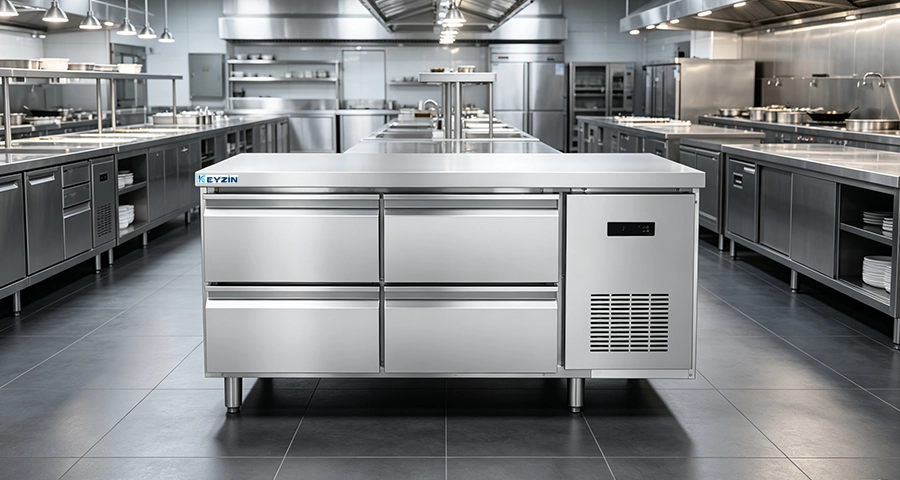
I ran into this exact mechanical problem during an early production run at my factory. We spent weeks testing drawer slide geometries to eliminate cold air loss, and I learned every technical detail that separates strong commercial hardware from cheap substitutes.
How Do Dynamic Load and Cycle-Life Standards Impact Drawer Performance?
Weak drawer tracks bend under heavy loads, and kitchen staff waste valuable minutes fighting jammed drawers. You cannot afford hardware breakdowns during busy dinner rushes.
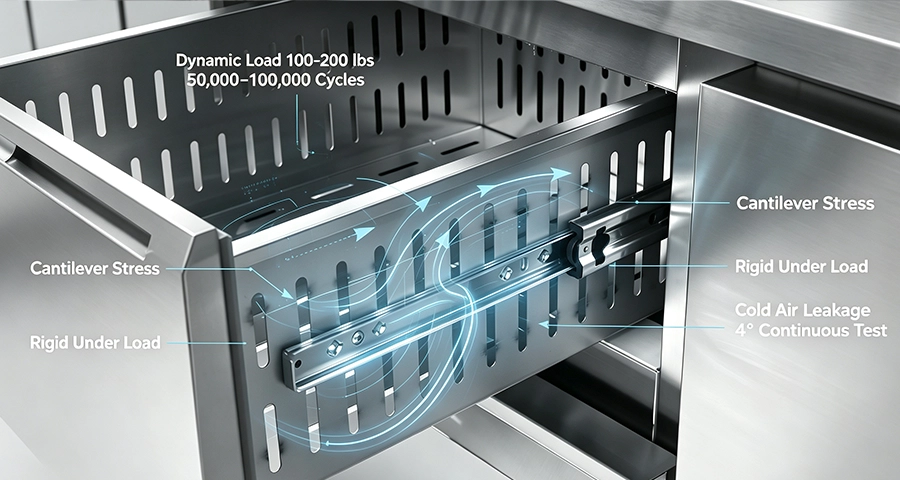
Commercial refrigeration slides require a dynamic rating between 100 and 200 pounds tested over 50,000 to 100,000 extension cycles. These testing benchmarks prevent track deflection, stop roller wear, and eliminate bearing cage displacement under heavy cantilever stress inside cold storage cabinets.
Understanding Dynamic Stress and Mechanical Deflection
I test all drawer assemblies under active dynamic weight rather than resting static weight. Static load ratings show what a slide holds while parked, but dynamic ratings prove how metal behaves when moving. Drawers pull forward and create severe cantilever stress on the rear mounting brackets. Cheap slides bend down at full extension, and this track sagging ruins the alignment of the drawer face. The magnetic perimeter gasket then loses contact with the cabinet breaker strip. Cold air leaks out, compressors run continuously, and ice forms on the evaporator coils. We run continuous cycle tests at 4°C to verify that the slide steel stays rigid under full loads.
| Hardware Metric | Minimum Requirement | Common Failure Mode | Impact on Equipment |
|---|---|---|---|
| Dynamic Capacity | 100 to 200 lbs | Track bending at front lip | Magnetic gasket air leaks |
| Cycle Durability | 50,000 to 100,000 cycles | Bearing cage collapse | Jammed drawer during service |
| Deflection Limit | Under 2.0 mm drop | Downward track tilt | Frame condensation and frost |
| Lubricant Rating | NSF H1 synthetic grease | Grease freezing at 2°C | Hard pulling and roller wear |
Why Choose 304 Stainless Steel Over Zinc-Plated Hardware?
Moisture and food salts destroy regular steel hardware, and rusty drawer slides quickly contaminate cold storage environments. You risk food safety violations when hardware surfaces chip.
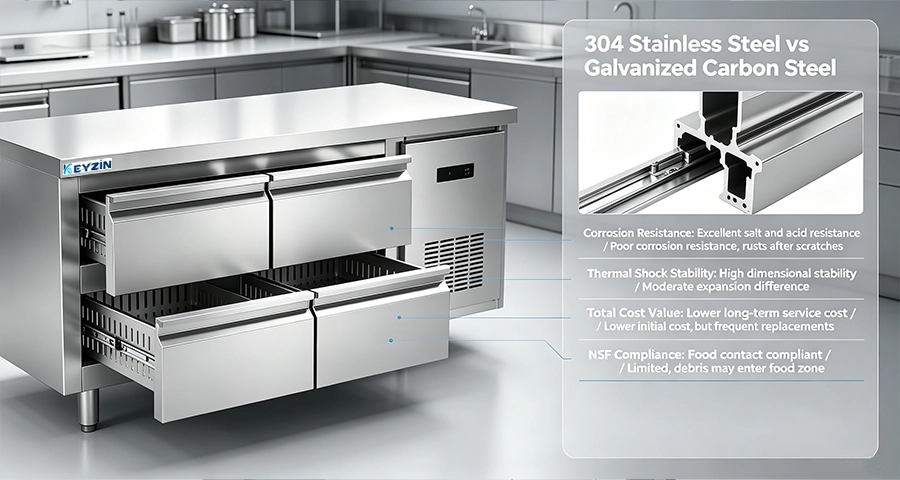
Grade 304 stainless steel resists food acids, moisture, and harsh chemical sanitizers, which prevents pitting and rust in humid units. Zinc-plated hardware costs less initially, but microscopic surface scratches cause quick oxidation, surface flaking, and rough mechanical binding in cold storage.
Material Composition and Thermal Realities
I spent years inspecting rusty returned slides before switching our factory baseline entirely to grade 304 stainless steel. Cold refrigeration units live at high relative humidity, and kitchen staff clean them with harsh chlorine or acid sanitizers. Zinc plating only creates a thin chemical skin over cheap carbon steel. Food pans scratch this skin during busy shifts, and moisture immediately attacks the raw steel underneath. Rust expands and freezes the internal ball bearings inside the track channels. Grade 304 stainless steel contains sufficient nickel and chromium to heal its own passive oxide layer, and it handles cold operating environments without cracking or flaking.
| Material Property | Grade 304 Stainless Steel | Zinc-Plated Carbon Steel |
|---|---|---|
| Corrosion Resistance | High resistance to salts and acids | Low resistance; rusts after scratches |
| Thermal Shock Stability | High dimensional stability | Moderate expansion differences |
| NSF Compliance | Fully approved for food contact | Restricted; flakes can enter food zones |
| Total Cost Value | Lower long-term service costs | Low initial cost but frequent replacement |
How Does Full-Extension Travel Improve Daily Ergonomics?
Chefs spill food and bend hardware when cabinet openings block drop-in pans. Short drawers cause dropped containers and slow kitchen prep down significantly.
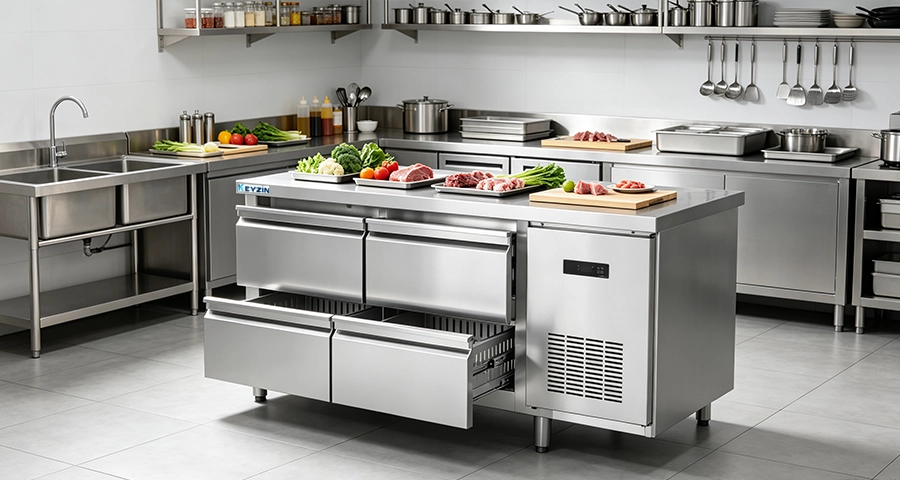
Full-extension and over-travel telescopic slides pull the entire drawer clear of the cabinet face. This complete clearance lets kitchen staff lift and lower standard gastronorm pans vertically into the drawer frame without tilting the containers or spilling liquids.
Travel Geometry and Frame Clearance
I always recommend telescopic three-section slides for commercial prep tables and undercounter units. Standard three-quarter extension slides leave several inches of the food pan tucked beneath the upper counter overhang. Kitchen staff must tip heavy metal pans at sharp angles to slide them out, which leads to spilled food inside the bottom of the cabinet. Full-extension hardware pulls the pan support frames completely out into the open room. Kitchen staff drop Gastronorm pans straight down into the wire racks with zero resistance. You also save the drawer faces from denting because cooks do not need to yank the handles sideways to clear the cabinet frame.
| Slide Extension Type | Pan Clearance | Spill Risk | User Ergonomics |
|---|---|---|---|
| 3/4 Extension | Poor; 20% of pan remains inside | High risk on deep liquid pans | Requires awkward angle lift |
| Full Extension | Complete; clears the cabinet face | Very low risk | Straight vertical lift |
| Over-Travel | Complete plus 1 inch extra clearance | None | Easiest access under overhangs |
Why Is Tool-Less Removal Necessary for NSF Washdown Compliance?
Dirty food debris collects inside drawer tracks, and bacteria grows rapidly in hard-to-reach hardware corners. Slow disassembly stops kitchen workers from cleaning drawers properly.
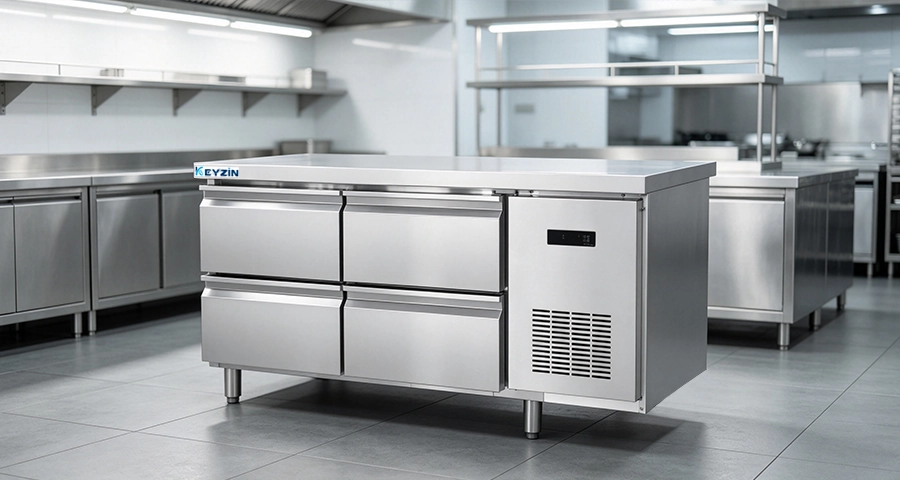
NSF and ANSI Standard 7 rules mandate tool-less drawer slide removal using quick-release tabs or lift-out latches. Kitchen workers can remove the entire drawer assembly by hand within seconds, which enables thorough daily sanitization without using screwdrivers.
Sanitation Engineering and Thermal Breaks
I design drawer assemblies so workers can strip them down in less than ten seconds. Health inspectors look closely at the corners behind drawer slides because food crumbs slide off prep tops and drop straight down into the tracks. If cleaning staff need a wrench or screwdriver to take the drawers out, they simply skip cleaning behind the panels. Quick-release levers allow anyone to pull the tracks, wash them in a sink, and wipe down the cabinet interior. You must also mount these slides with non-metallic isolation shims against the cabinet liner. These composite breaks stop cold metal from touching the warm outer frame, which prevents external condensation puddles on your floor.
| Design Feature | Functional Requirement | Food Safety Advantage |
|---|---|---|
| Quick-Release Latches | Hand-operated disconnect buttons | Allows fast daily sanitization |
| Open Slide Profiles | No hidden closed pockets | Prevents stagnant liquid pools |
| Composite Mounting Shims | Thermal isolation from cabinet walls | Stops exterior condensation sweat |
| NSF H1 Greases | Low-temperature food-grade lube | Safe for accidental food contact |
Conclusion
Choose 304 stainless steel slides with 100-pound dynamic ratings, full extension, and tool-less release to ensure long service life, food safety compliance, and tight cabinet sealing.