
Warm food pans spoil expensive ingredients quickly during a busy service. Food safety violations and ruined inventory cost you serious money. Choosing the wrong prep table ruins your entire kitchen line.
Forced-air prep tables circulate cold air over and under food pans to maintain temperatures below 41°F with open lids. Cold-wall tables cool only by metal contact through copper coils, making them suitable only for short, closed-lid prep shifts.
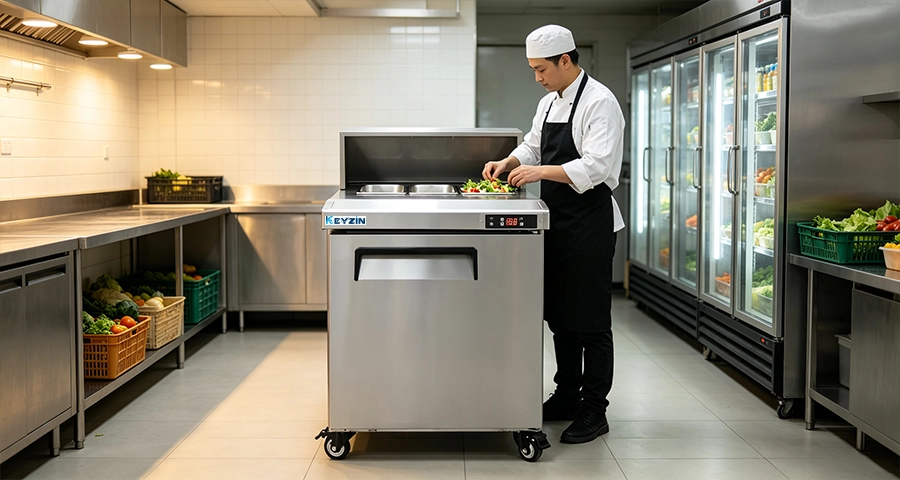
I have tested and inspected hundreds of commercial refrigeration units over the years. I often see kitchen operators buy the wrong cooling design because the exterior stainless steel looks identical. You need to understand how these machines handle heat so you do not waste your capital on bad equipment.
Cold-Wall Limitations: Why Do Bottom-Chilled Pans Fail at Peak Hours?
Kitchen lines become extremely hot during the lunch rush. Uncovered ingredients warm up quickly in open pans. Serving spoiled food leads to customer complaints, failed health inspections, and expensive food waste.
Cold-wall tables fail during peak hours because they rely only on conductive cooling from the metal well walls. The food pan bottom freezes, while ambient kitchen air warms the top food layer above the safe 41°F threshold.
The Physics of Conductive Cooling Failure
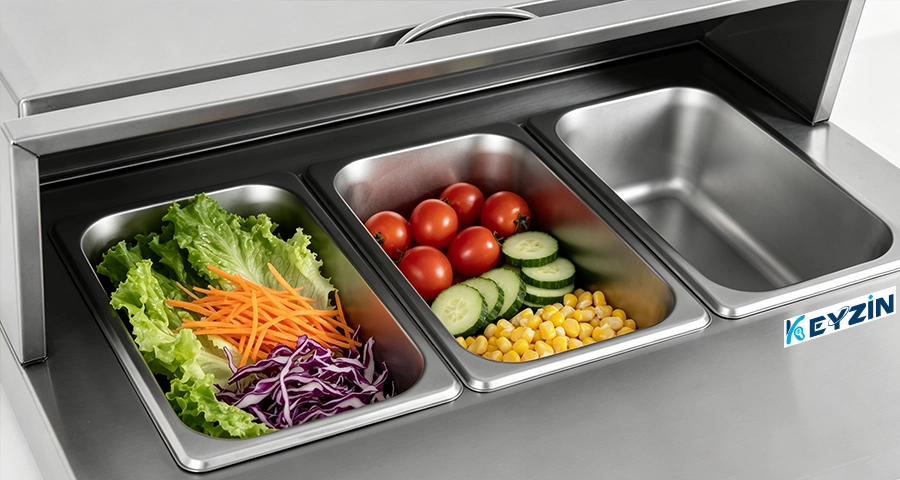
I have spent many hours taking temperature readings across open pan rails. Cold-wall prep tables weld copper refrigeration lines directly to the outer surface of the stainless steel rail. Cold travels solely through direct physical contact. The copper lines cool the steel rail, the steel rail cools the food pan, and the food pan cools the food product. This method creates a severe vertical temperature gradient inside every pan. The food at the bottom of the pan often drops to 28°F and freezes into a solid block. At the same time, ambient air warms the top surface. The top two inches of food regularly climb past 45°F during a standard two-hour service rush.
The physical depth of your pans makes this problem even worse. A standard four-inch pan performs reasonably well under cold conduction. However, a six-inch pan suffers massive thermal loss because conductive cooling weakens as distance from the cold metal wall increases.
Moisture creates another operational failure point in cold-wall wells. Warm humidity from the kitchen hits the bare cold steel walls and freezes into a thick crust of frost. This layer of frost acts as a thermal blanket. The frost actually blocks heat transfer between the rail and your pans. Kitchen staff must shut down the unit, transfer all ingredients to a walk-in cooler, and scrape the ice off by hand. Cold-wall tables do not use internal fans, so they run completely silent and will not dry out delicate toppings. Even so, they cannot hold proper food temperatures when lids remain open during busy rushes.
| Operating Parameter | Cold-Wall System | Practical Kitchen Result |
|---|---|---|
| Heat Transfer Method | Direct metal-to-metal conduction | Bottom freezes while top surface warms up |
| Pan Depth Limit | Best with 4-inch deep pans | 6-inch pans suffer severe heat spikes on top |
| Defrost Requirement | Manual shutdown and manual scraping | Regular downtime and added labor costs |
| Air Movement and Noise | Zero fans and zero air movement | Delicate toppings retain moisture without drying |
Ring Duct Engineering: How Does Top-Pan Air Recirculation Work?
Hot air from ovens and fryers constantly assaults your open prep rail. Ingredient temperatures rise dangerously within minutes. Unsafe holding temperatures force your staff to throw away valuable food batches daily.
Ring duct engineering works by discharging a continuous blanket of cold air from perimeter vents across the top of all pans. This air curtain blocks kitchen heat, flows down the pan sides, and returns underneath.
Managing Convective Airflow and Pan Enveloping
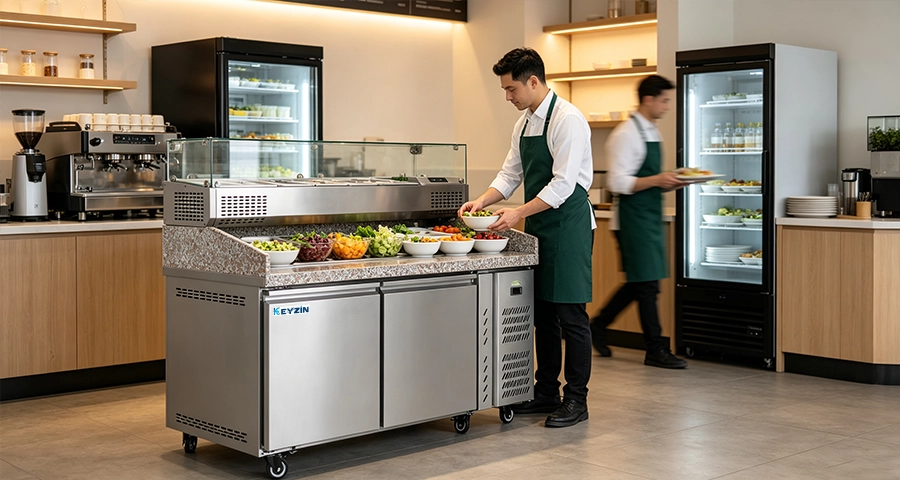
I always pay close attention to internal ductwork when I evaluate forced-air tables. Instead of relying on metal contact, a forced-air prep table uses continuous convective airflow. An evaporator fan pulls air across a finned cooling coil. The fan pushes this chilled air into a hollow channel that wraps around the entire upper perimeter of the rail. This channel is called a ring duct. The duct discharges a flat, laminar sheet of cold air directly across the open tops of the food pans. This cold air curtain acts as a physical barrier against room heat. The air sweeps across the pans, drops down the side gaps, cools the bottom surfaces, and enters a return intake below.
This continuous air envelope maintains uniform temperatures throughout the entire depth of the pan. You can run deep six-inch pans all day without freezing the bottom or warming the top. However, this moving air system introduces two distinct operational challenges that you must manage.
First, strong air drafts from kitchen exhaust hoods or ceiling vents can ruin this protection. If air drafts blow faster than 50 feet per minute across the counter, the draft shears the cold air curtain away. The pans will warm up even if the compressor runs at full power. Second, constant air movement draws moisture out of delicate foods. Sliced cheese, shredded lettuce, and diced tomatoes dry out on the surface if your product turnover is slow. Furthermore, loose food toppings can fall into the perimeter air slots. You must ensure the unit has removable intake screens. Without these screens, dropped food debris will choke the blower motor and ruin cooling performance.
| System Parameter | Engineering Standard | Practical Kitchen Impact |
|---|---|---|
| Cold Air Path | Horizontal perimeter curtain | Blocks ambient room heat from entering open pans |
| Product Moisture Impact | Moderate surface dehydration | Requires steady product turnover during shifts |
| Return Air Intake | Low-pressure intake beneath pans | Catches falling food crumbs and needs cleaning |
| Kitchen Draft Limit | Below 50 feet per minute | Strong hood drafts blow the cold air curtain away |
Energy & Compressor Load: Does Open-Lid Operation Work with R-290?
Leaving prep table lids open pulls massive amounts of heat into the storage cabinet. Compressors run constantly, internal components wear out quickly, and electric bills climb. Frequent equipment breakdowns destroy your kitchen margins.
Open-lid prep work functions reliably with R-290 refrigerant because propane carries a high latent heat of vaporization. It pulls heat out of the cabinet rapidly during open-lid operation while consuming less electricity and reducing run times.
Refrigerant Thermodynamics and Ambient Heat Standards
I regularly monitor power meters during commercial kitchen equipment tests. When cooks leave the pan rail cover open during a four-hour lunch rush, warm air pours into the cooling compartment. The refrigeration system must remove this incoming heat instantly. Older equipment that uses R-134a or R-404A struggles under this heavy load. Those older refrigerants absorb less heat per pound of gas. The compressors must run for long periods without stopping. The motors get extremely hot, consume heavy electrical current, and suffer mechanical failure early.
Modern systems use R-290 natural propane refrigerant to solve this thermal load problem. R-290 possesses superior thermodynamic properties, especially a high latent heat of vaporization. The refrigerant absorbs a massive amount of heat as it boils inside the evaporator tubes. This high absorption rate allows the system to pull rail temperatures down quickly even when the lid stays open. The compressor cycles off sooner, runs much cooler, and uses significantly fewer total amps.
You must also check the NSF-7 certification rating on the serial tag. An NSF-7 Type I unit is certified to hold food below 41°F only in rooms up to 80°F ambient temperature. A busy commercial cook line easily reaches 85°F or higher near griddles and broilers. A Type I table will fail to keep food safe in that environment. You must specify an NSF-7 Type II rating. Type II equipment passes rigorous testing in ambient temperatures up to 86°F. When you combine an NSF-7 Type II design with R-290 refrigerant, the prep table handles heavy open-lid service without overheating the compressor.
| Technical Factor | Older Refrigerants (R-134a / R-404A) | Modern Hydrocarbon (R-290) |
|---|---|---|
| Heat Absorption Rate | Lower latent heat of vaporization | High latent heat for rapid temperature pull-down |
| Compressor Duty Cycle | Runs almost continuously with open lids | Cycles off quickly and runs much cooler |
| Electrical Draw | Higher running amps and higher power bills | Lower running amps and reduced energy cost |
| Ambient Heat Threshold | Commonly limited to NSF-7 Type I (80°F) | Built to satisfy NSF-7 Type II (86°F) |
Dealer Checklist: What Are 5 Technical Questions to Ask Factory Engineers?
Buying a commercial prep table based only on price and external dimensions causes severe operational headaches. Substandard mechanical parts hide behind polished stainless steel sheets. You discover poor cooling only when your kitchen is full of orders.
Ask factory engineers about the NSF-7 ambient rating, pan depth certification, defrost method, return duct filters, and fan motor types. These five direct questions prove whether the prep table can survive heavy commercial use.
How to Inspect Internal Build Quality
I always tell buyers to look past the shiny exterior panels when they evaluate equipment. Polished metal can easily conceal a cheap compressor, thin foam insulation, or bad air channels. You should speak directly with factory technical representatives and ask very specific engineering questions before you issue a purchase order.
First, ask for the exact NSF-7 testing class. Ask if the table holds 41°F at an 80°F room ambient or an 86°F room ambient. If you plan to install the table on an active cook line, you must insist on Type II certification. Second, ask if the cooling system is rated for six-inch deep food pans. Many budget tables only cool four-inch pans effectively, which forces your kitchen staff to refill ingredients constantly. Third, ask how the system removes frost from the evaporator coil. Cold-wall systems require manual shutdowns, while quality forced-air units use automated off-cycle or electric defrost timers.
Fourth, ask about food scrap protection around the air return vents. Ask if the table features tool-free removable filter plates. If food scraps fall straight into the evaporator coil, the cooling fins will clog with mold, restrict airflow, and create bad odors. Fifth, ask what kind of fan motors power the air circuit. Older shaded-pole motors waste electricity and dump motor heat directly into the refrigerated compartment. Modern electronically commutated motors use 60 percent less power, generate almost no motor heat, and last significantly longer in daily commercial service.
| Engineering Question | Target Technical Specification | Operational Benefit |
|---|---|---|
| 1. What is the certified NSF-7 rating? | NSF-7 Type II (tested at 86°F) | Keeps food safe near hot cooking equipment |
| 2. Does cooling cover 6-inch deep pans? | Full convective envelope for 6-inch pans | Holds more prep food without warm surface spots |
| 3. Which defrost mechanism is installed? | Automatic timed off-cycle defrost | Prevents ice buildup without manual staff labor |
| 4. Are return air ducts fully protected? | Tool-free removable filter plates | Prevents falling food from choking the fan coil |
| 5. What evaporator fan motors are used? | EC (electronically commutated) motors | Lowers power draw and stops extra heat inside |
Conclusion
Forced-air tables maintain safe open-pan temperatures during intense kitchen rushes, while cold-wall tables suit closed-lid holding. Match your kitchen ambient heat to the right cooling design to safeguard your food.