
Are you tired of buying commercial reach-in chillers that break down under kitchen heat and ruin your margins? Poor cooling, bad stainless steel, and cramped layouts cost businesses thousands.
Commercial reach-in refrigerators and freezers provide heavy-duty food storage for foodservice facilities. Smart buyers check true net capacity, Grade 304 stainless interiors, R290 refrigerant systems, and door clearance before purchasing. Sourcing the right unit prevents premature compressor failure, keeps food safe, and lowers operating costs over decades.
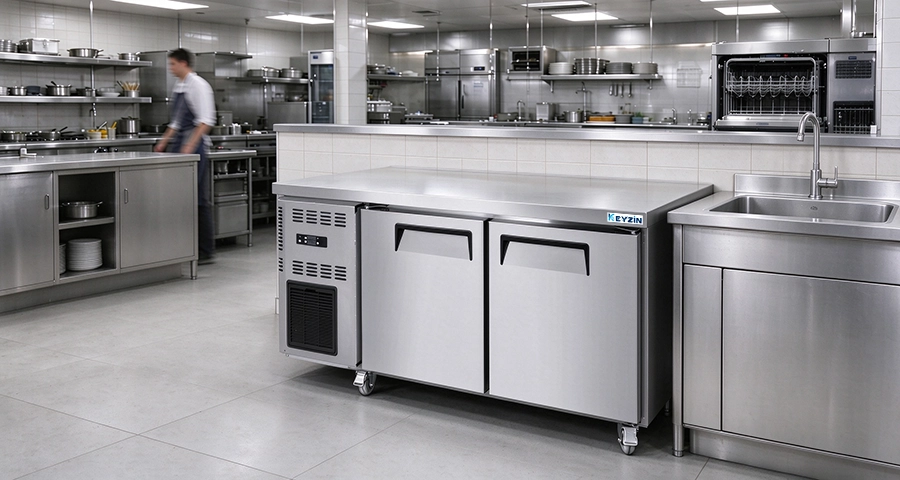
I have spent years managing commercial kitchen equipment manufacturing in Guangzhou, China. I see buyers make critical sourcing mistakes every single week. Sourcing commercial refrigeration is never as simple as looking at a catalog page. You must look past sales brochures to examine raw sheet metal, thermal design, and internal engineering.
How to Calculate Actual Reach-In Capacity and Kitchen Footprint?
Are you struggling with reach-in cabinets that fail to fit your kitchen layout or hold your daily food prep? Cramped kitchens and overloaded shelves destroy daily kitchen productivity.
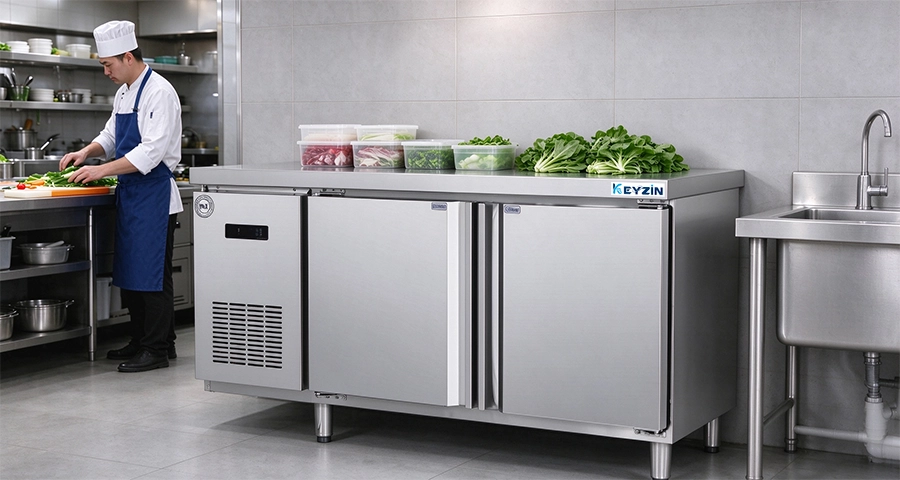
Calculate true reach-in capacity by subtracting evaporator fans, ducting, and required airflow zones from gross volume. Then, add caster height, ventilation clearance, and full door-swing clearance to your room layout. This planning guarantees steady airflow, prevents kitchen line bottlenecks, and protects your refrigeration compressors from premature overheating.
1.1 Gross vs. Usable Net Volume
I always warn buyers about spec sheets. Advertised gross volume often overstates usable storage by 15% to 25%. Evaporator housings, fan shrouds, internal air channels, and required air buffer zones take up substantial internal space. When you pack an interior completely full, air circulation stops. The evaporator coil freezes up and your food temperatures rise dangerously.
1.2 1, 2, and 3-Door Sizing
You must choose the number of doors based on kitchen volume and menu needs. Single-door units fit tight prep stations. Two-door cabinets handle standard kitchen lines. Three-door units serve high-volume storage. Each extra door increases structural frame width and changes power requirements.
1.3 Depth and Swing Clearance
A standard footprint plan must factor in caster height and rear mechanical ventilation space. Units need 4 to 6 inches of clearance behind and above the cabinet. You must also map the 90-degree to 120-degree door swing arc. Without this clearance, kitchen staff bump into open doors and create dangerous traffic bottlenecks.
| Door Setup | Nominal Width | Real Usable Volume Loss | Minimum Ventilation Gap |
|---|---|---|---|
| 1-Door Reach-In | 27 to 29 Inches | ~15% (Coil & Shrouds) | 4 Inches Rear / Top |
| 2-Door Reach-In | 52 to 55 Inches | ~20% (Central Mullion & Airway) | 5 Inches Rear / Top |
| 3-Door Reach-In | 78 to 82 Inches | ~25% (Dual Evaporators & Ducts) | 6 Inches Rear / Top |
How Does Stainless Steel Selection Impact Long-Term Durability?
Does your kitchen refrigeration suffer from pitted cabinet floors and rust spots from caustic sanitizers? Cheap sheet metal ruins good equipment and triggers costly health code violations.
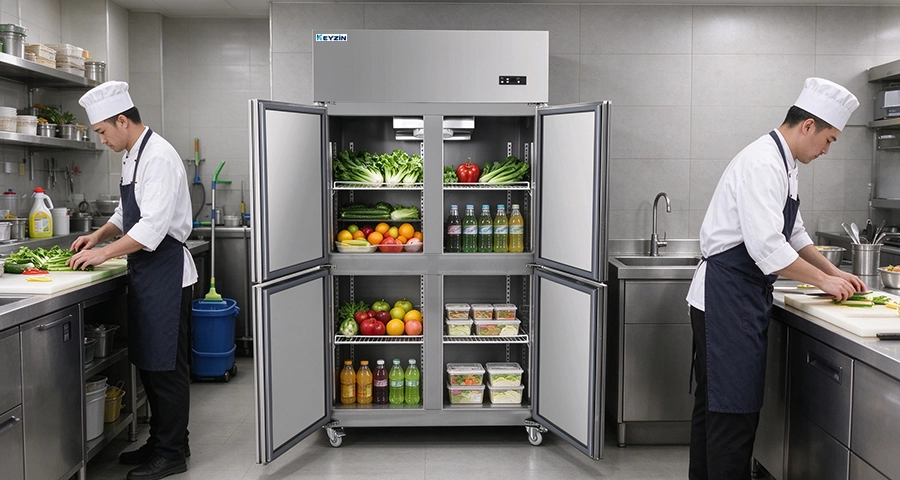
Stainless steel durability depends on alloy chemistry, panel thickness, and sanitary construction. Units built with Grade 304 interiors resist food acids, harsh sanitizers, and floor pitting. Grade 430 exteriors cut raw material costs while keeping structural rigidity. Meeting NSF standards ensures seamless coved corners for rapid and thorough cleaning.
2.1 304 vs. 430 Stainless Steel
I see many low-cost units use Grade 430 steel throughout the entire cabinet. Grade 430 is a ferritic alloy that contains chromium but lacks nickel. It works fine for dry exterior walls. But Grade 304 austenitic steel contains both chromium and nickel. It offers much higher protection against moisture and corrosive attacks.
2.2 Corrosion & Acid Resistance
Food storage creates severe chemical stress. Vinegar, citrus juice, and salt brine spill onto reach-in cabinet floors. Commercial kitchens also scrub interiors with aggressive chemical sanitizers. Low-grade steel pits rapidly under these chemicals. Once pitting starts, microscopic rust holes puncture the cabinet liner and expose the insulation foam beneath.
2.3 NSF Hygiene Compliance
Hygiene rules require smooth, non-porous surfaces. Professional reach-in models feature curved interior corners rather than sharp welded seams. These coved edges stop bacteria from hiding in cabinet crevices. They allow cleaning crews to sanitize surfaces quickly during busy shift turnovers.
| Steel Grade | Alloy Composition | Best Placement | Corrosion Resistance |
|---|---|---|---|
| AISI 304 | 18% Chromium, 8% Nickel | Interior Walls, Floor Pan | High (Resists food acids) |
| AISI 430 | 16-18% Chromium, 0% Nickel | Exterior Doors, Side Panels | Moderate (Dry areas only) |
| Galvanized | Zinc-Coated Base Steel | Rear Backing, Base Plates | Low (Rusted by wet cleanings) |
How Do You Ensure Proper Shelving Strength and Pan Compatibility?
Are your kitchen storage shelves bowing under heavy sauce pots or dropping trays because brackets slipped? Collapsing shelves destroy expensive food stock and create major kitchen injury risks.
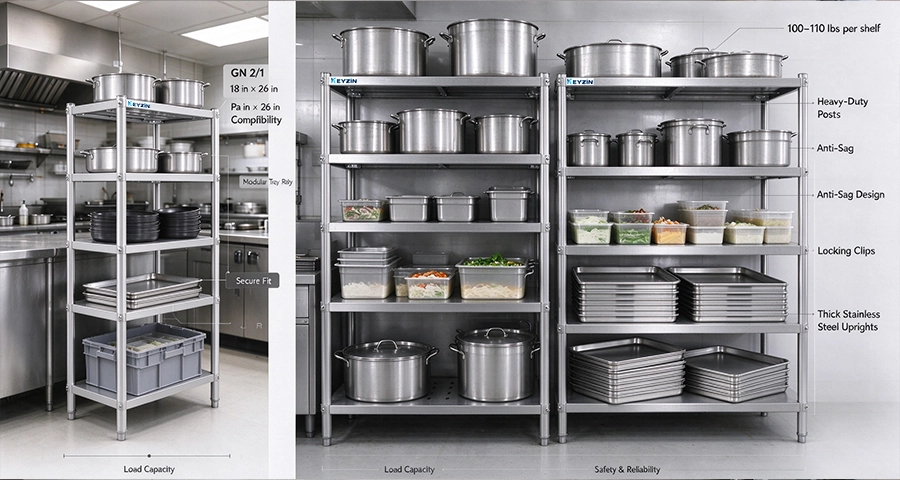
Ensure shelving reliability by matching heavy-gauge wire racks and locking clips to required pan standards. Select modular tray slides for European Gastronorm (GN 2/1) or North American 18″ x 26″ sheet pans. Quality units use heavy-duty pilasters rated for at least 100 to 110 pounds per shelf.
3.1 Gastronorm (GN) Pan Fitment
I frequently catch pan compatibility errors during export shipments. North American foodservice operations rely heavily on 18″ x 26″ sheet pans. International kitchens use European Gastronorm (GN 2/1 and GN 1/1) pan dimensions. If your unit has fixed wire shelves instead of modular universal tray slides, sheet pans tip over and jam the door frames.
3.2 Weight Capacity & Sag Prevention
A full pan of marinated meat or soup stock weighs a substantial amount. Commercial shelving must carry a minimum working load of 100 to 110 pounds per shelf. Inferior wire racks use thin wire gauges and cheap spot welds. These racks sag in the center under load, causing liquid containers to slide and spill.
3.3 Pilaster and Clip Strength
Shelves are only as strong as their mounting brackets. Weak sheet-metal tabs bend easily when workers drop heavy crates onto shelves. Look for heavy-gauge stainless steel pilasters that run along the internal walls. Use positive-locking support clips that seat firmly into mounting slots to prevent accidental shelf collapses.
| Standard Type | Pan Dimension | Optimal Slide Style | Load Rating Per Tier |
|---|---|---|---|
| Gastronorm GN 2/1 | 650 mm x 530 mm | Universal U-Channel Slides | 110 lbs (50 kg) Minimum |
| Sheet Pan | 18″ x 26″ (457 x 660 mm) | Universal Wire or Angle Slides | 110 lbs (50 kg) Minimum |
| General Storage | Standard Wire Racks | 4-Point Pilaster Clips | 100 lbs (45 kg) Minimum |
Which Door Hardware Features Guarantee Long Seal Integrity?
Do worn refrigerator door gaskets leak cool air, create condensation puddles, and burn out your compressor? Defective door hardware causes massive energy waste and persistent temperature alarms.
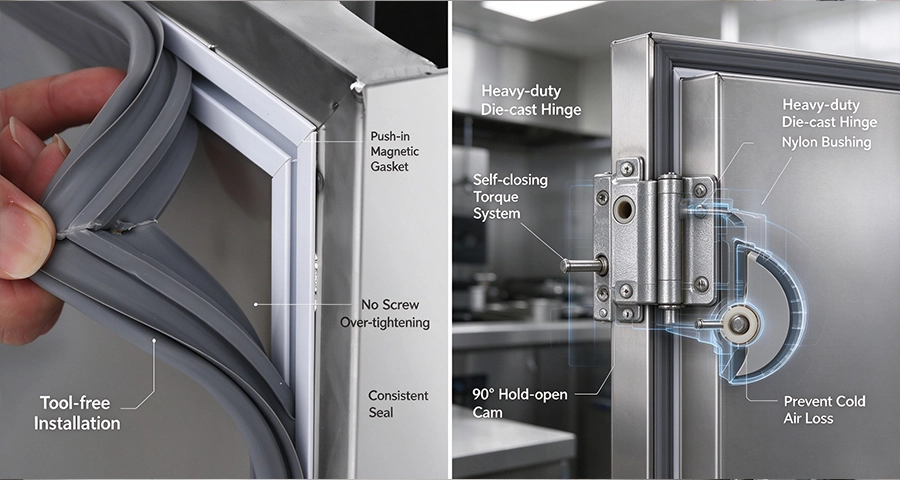
Guarantee seal integrity by specifying push-in dart magnetic gaskets, heavy-duty self-closing hinges, and 90-degree stay-open cams. Tool-free dart gaskets allow fast replacements without uneven screw torque. Heavy-duty die-cast hinges ensure doors close completely, prevent cold air loss, and stop moisture accumulation around the cabinet frame.
4.1 Self-Closing & 90° Stay-Open
Kitchen staff work in fast-paced environments. They carry heavy hotel pans in both hands. If a refrigerator door lacks a self-closing cam, staff leave doors slightly ajar. Quality reach-in units feature self-closing torsion systems that pull doors shut from 45 degrees, combined with a 90-degree hold-open stop for easy morning restocking.
4.2 Heavy-Duty Hinge Reliability
Refrigeration doors take thousands of hard slams every month. Standard light-duty hinges sag over time under this weight. When the hinge pin drops even a few millimeters, the door sags and hits the bottom sill. I always look for heavy-duty zinc die-cast or stainless steel hinges with internal nylon bushings that resist mechanical wear.
4.3 Magnetic Gaskets & Seal Integrity
Gasket design makes a huge difference in field maintenance. Old systems use screw-retained tracks. Technicians overtighten screws during repairs, distort the rubber profile, and create air gaps. Modern units use tool-free push-in dart-style magnetic gaskets. You can pull them out and press new ones into the door channel in minutes without tools.
| Hardware Component | Common Failure Mode | Recommended Specification | Maintenance Benefit |
|---|---|---|---|
| Door Hinge | Sagging pin, hinge drop | Heavy-Duty Zinc Die-Cast / Stainless | Prevents door edge drag |
| Perimeter Gasket | Tearing, seal gaps | Tool-Free Push-In Dart Profile | 5-Minute toolless swap |
| Closing Mechanism | Broken internal spring | Gravity-Assisted Cam Rise System | Consistent closing torque |
What Cooling Systems Deliver Maximum Energy Efficiency?
Are your commercial chillers freezing up during hot summer rush hours and driving up electric bills? Inefficient refrigeration systems struggle in hot kitchens and risk spoiled inventory.
Maximize cooling efficiency by selecting hydrocarbon R290 refrigerant systems matched to your kitchen environment. R290 cuts power draw by up to 30% and complies with environmental rules. Use bottom-mounted compressors for cooler cook lines, or top-mounted units for bakeries to prevent airborne flour from choking the condenser coil.
5.1 Performance in High-Heat Kitchens
Commercial kitchens regularly hit 40°C (104°F) ambient temperatures near fryers, ranges, and combi ovens. A low-grade refrigeration system cannot shed heat fast enough in these hot spaces. The unit runs continuously, internal temperatures creep up, and the compressor trips on thermal overload. You need robust condensing units designed for high-heat environments.
5.2 R290 Refrigerant & Regulations
The industry has moved toward hydrocarbon R290 natural refrigerant. Hydrocarbon R290 features a near-zero Global Warming Potential and zero Ozone Depletion Potential. More importantly, R290 thermodynamic properties reduce energy consumption by up to 30% compared to old HFC gases like R134a or R404A. This cuts power bills while satisfying strict environmental regulations.
5.3 Top vs. Bottom Compressor Mount
Compressor position depends on kitchen layout. Bottom-mounted units draw cooler air from the kitchen floor and place shelves at an ergonomic working height. However, grease and floor dust collect down there. Top-mounted units draw cleaner air away from floor grease. They are essential in bakeries, where airborne flour settles on the floor and clogs bottom-mounted condenser fins.
| Parameter | Top-Mounted Compressor | Bottom-Mounted Compressor |
|---|---|---|
| Air Temperature Drawn | Warmer ambient air (Rises) | Cooler floor-level air (~5°F cooler) |
| Flour / Grease Exposure | Protected from floor dust | High risk of floor dirt and debris |
| Storage Ergonomics | Low bottom shelf, bending required | Ergonomic, raised bottom storage |
| Ideal Application | Bakeries, flour-heavy kitchens | Cook lines, hot grease environments |
How to Conduct B2B Sourcing and Factory Quality Inspections?
Are you tired of receiving overseas refrigeration shipments with dented panels, missing certifications, and internal foam voids? Inconsistent factory quality control ruins business relationships and profit margins.
Conduct successful B2B sourcing by demanding ASTM F2143 pull-down testing, cyclopentane foam density audits, and guaranteed spare parts support. Inspect electrical wiring, ground continuity, and helium leak testing during factory visits. Insist on a multi-year warranty on compressors and an available stock of controllers, sensors, and fans.
6.1 Factory Inspection Checklist
When I run factory inspections, I never trust simple idle temperature tests. A refrigerator can hold temperature while empty in a cool showroom. You must require an ASTM F2143 pull-down test and a thermal recovery curve check. The unit must pull down to safe holding temperatures quickly after repeated door openings.
You must also evaluate polyurethane insulation density and cyclopentane blowing agents. Poor chemical mixing creates foam voids inside the cabinet walls. These internal voids cause condensation sweating on exterior steel panels and force the compressor to run nonstop until it burns out.
6.2 Warranty & Spare Parts Support
Refrigeration breakdowns require immediate repairs. A dead cooler risks thousands of dollars in spoiled meat and dairy. B2B sourcing contracts must include guaranteed local availability of critical wear items. Always secure replacement digital controllers, temperature probe sensors, evaporator fan motors, and extra door gaskets before clearing production runs.
| Inspection Step | Test Method | Target Standard | Failure Consequence |
|---|---|---|---|
| Thermal Pull-Down | ASTM F2143 Test Chamber | Pulls down to <4°C rapidly | Food spoilage during rushes |
| Insulation Integrity | Ultrasonic / Cut-Section Audit | High-density foam, zero voids | Cabinet sweating, compressor burnout |
| Refrigerant Circuit | Helium Sniffer Detection | Zero micro-leaks (<1g/year) | Gradual cooling performance loss |
| Electrical Safety | Hipot and Ground Continuity | Full CE / ETL / NSF Compliance | Shock hazards, import delays |
Conclusion
Sourcing quality commercial reach-in refrigeration requires verifying true net storage, Grade 304 stainless interiors, R290 cooling efficiency, heavy-duty door hardware, and rigorous factory testing to ensure long-term kitchen performance.