
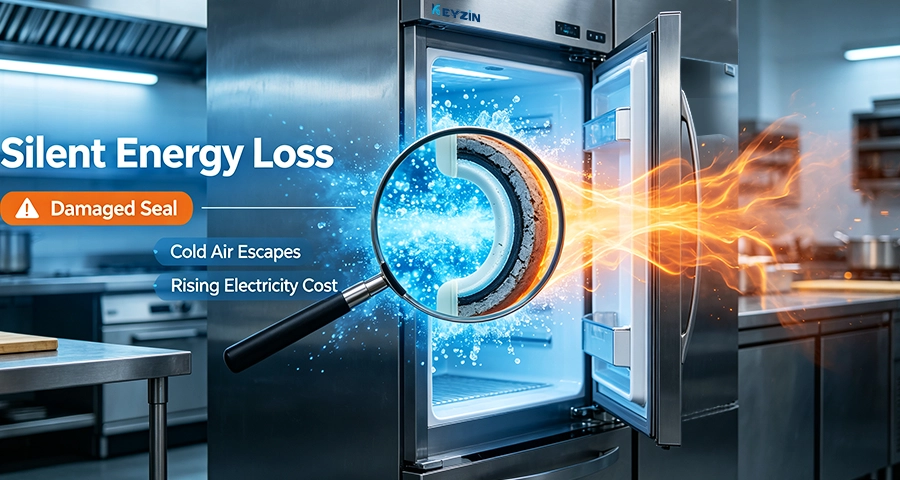
Are high electricity bills ruining your commercial kitchen profit margins? Worn refrigerator door seals quietly leak cold air every single second. This invisible defect causes your compressor to overwork and fail early.
Yes, magnetic gasket failure directly increases commercial refrigerator energy consumption by up to 25%. Damaged seals allow warm air to enter constantly. This thermal leak forces compressors to run continuously, driving up electricity costs and accelerating hardware wear across commercial kitchens.
I have spent years running my kitchen equipment manufacturing plant in Guangzhou. I often see restaurant owners replace expensive compressors when the real problem is just a simple rubber seal. Understanding this small part will save you thousands of dollars in utility bills and prevent emergency equipment downtime.
The Hidden OpEx Trap: How High-Frequency Door Access Destroys Refrigerator Seals?
Are your kitchen doors opening constantly during busy dinner rushes? Repeated slamming degrades magnetic door seals faster than you think. You end up paying massive energy bills without realizing why.
High-frequency door access causes severe thermal shock and mechanical stress on refrigerator seals. Opening doors 100 to 200 times per shift causes rapid temperature fluctuations. This process degrades seal elasticity and accelerates permanent physical warping.
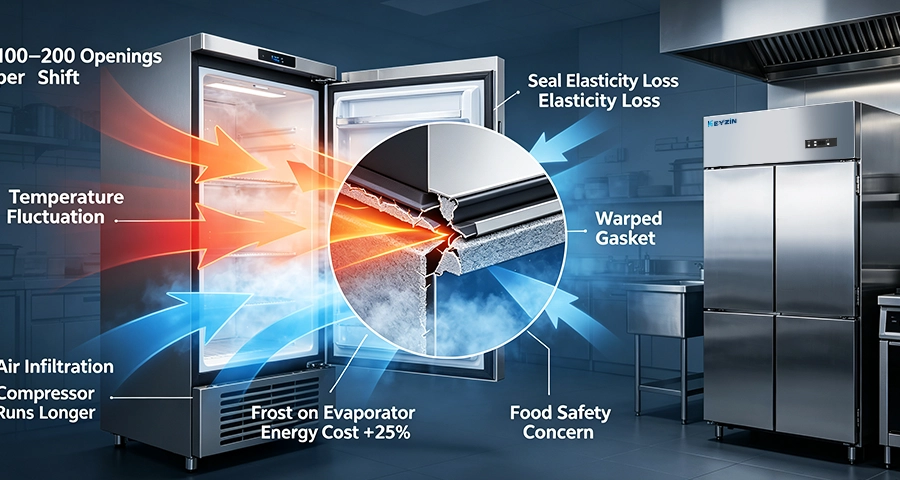
100 to 200 Door Opens per Shift: Thermal Shock in Commercial Kitchen Environments
In a busy commercial kitchen, line cooks open reach-in coolers between 100 and 200 times during every single shift. Every time the door swings open, heavy cold air rushes out. Warm and humid ambient kitchen air rushes inside. This instant exchange creates severe thermal shock inside the cabinet. The internal air temperature spikes instantly. The compressor must kick on immediately to cool the space down. When seals are loose, warm air continues to seep inside even after the door closes. Frost forms rapidly on the evaporator coils. Frost acts like an insulator. It blocks heat transfer. The system works twice as hard to reach safe temperatures. Micro-gaps in worn gaskets cause localized temperature spikes near door perimeters. This compromises food safety standards even when central cabinet temperature sensors report normal readings.
The Physical Breakdown of Standard PVC Gaskets: Cracking, Hardening, and Permanent Deformation
Standard door seals are made from polyvinyl chloride. Engineers add chemical plasticizers to make PVC soft and flexible. Heat and friction strip these plasticizers away over time. The material hardens. It becomes brittle. The continuous mechanical impact from door slamming flattens the hollow air chambers inside the gasket profile. The magnet inside loses its alignment. The gasket stays crushed instead of springing back. Microscopic gaps open along the corners. Warm air leaks in constantly. Damaged or misaligned magnetic gaskets cause continuous warm air infiltration. This process elevates refrigeration energy consumption by up to 25%.
| Impact Factor | Standard Operating Condition | Severe Seal Failure Condition |
|---|---|---|
| Compressor Run Time | 10 to 12 hours per day | 18 to 22 hours per day |
| Internal Temperature Variation | Stability within +/- 1°C | Spikes up to +/- 5°C near perimeter |
| Evaporator Coil Frosting | Normal daily defrost cycles | Heavy icing, requiring manual defrosts |
| Monthly Energy Cost Impact | Baseline standard | Increases by 15% to 25% |
Material Matters: Why Traditional PVC vs Food-Grade Silicone Gaskets?
Do you find yourself replacing cracked refrigerator gaskets every few months? Cheap materials fail quickly in harsh kitchen environments. Upgrading your gasket material solves this problem permanently.
Food-grade silicone gaskets outperform traditional PVC seals in every durability test. Silicone retains flexibility across extreme temperature ranges. It resists chemical breakdown from grease, animal fats, and harsh cleaning agents much better than standard plastic materials.
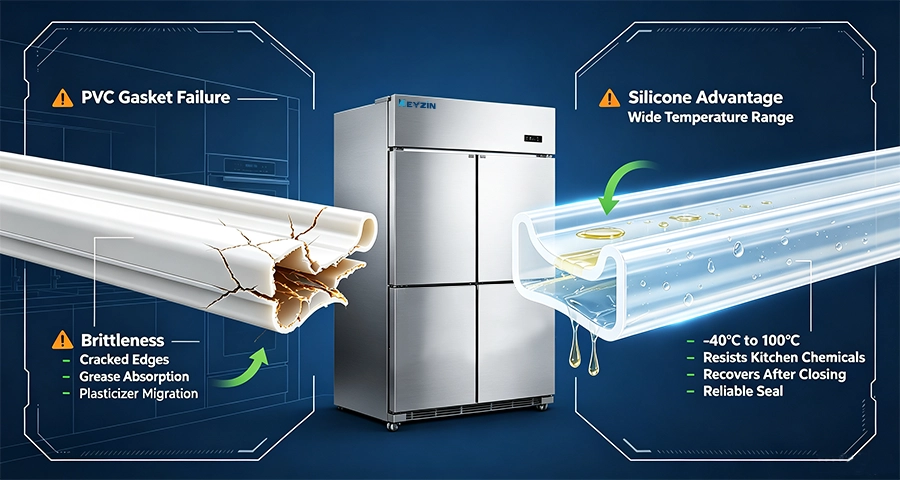
Thermal Stability and Elasticity Recovery under Heavy Daily Usage
I tested many gasket materials in my own production lines over the past decade. Traditional PVC seals harden quickly when cold and warp easily when exposed to external ambient heat. Silicone is completely different. Food-grade silicone gaskets retain flexibility and magnetic sealing forces over far wider temperature ranges. They handle longer operational lifecycles than traditional PVC materials. Silicone maintains soft elasticity from minus forty degrees to over one hundred degrees Celsius. When a kitchen staff member slams the door, silicone springs back into its original shape instantly. The magnetic strip inside stays flat against the stainless steel door frame. The airtight seal remains intact even after hundreds of thousands of door closures.
Chemical Degradation Resistance against Kitchen Oils, Grease, and Saniclad Cleaners
Commercial kitchens are harsh environments for polymers. Hot cooking oil splatters onto refrigerator doors constantly. Nightly cleaning crews spray strong chemical sanitizers everywhere. Standard PVC gaskets experience plasticizer migration and chemical breakdown when exposed to kitchen greases and harsh sanitizers. This exposure leads to brittle cracking and permanent deformation. PVC absorbs airborne grease and fats. The oils leach out the internal plasticizers. The PVC gasket turns hard, dark, and brittle within months. Food-grade silicone resists chemical attack from animal fats, vegetable oils, and harsh commercial disinfectants. It does not swell, rot, or crack. It keeps its smooth surface. This makes it easy to wipe down without tearing the magnetic pocket.
| Property Comparison | Traditional PVC Gaskets | Food-Grade Silicone Gaskets |
|---|---|---|
| Service Lifespan | 6 to 12 months | 36 to 60 months |
| Cold Flexibility Range | Poor below 0°C | Excellent down to -40°C |
| Chemical Fat Resistance | Low (Hardens easily) | High (No chemical degradation) |
| Elastic Recovery Rate | Low (Stays deformed) | High (Instant shape recovery) |
Eliminating Labor Bottlenecks: How Tool-Less Removable Gaskets Save Maintenance?
Is your maintenance staff spending hours screwing down old refrigerator seals? High labor repair costs eat away at your operational budget. Tool-less gaskets make maintenance fast and effortless.
Tool-less snap-in gaskets cut door seal replacement time from forty-five minutes down to under five minutes per door. Staff can easily pull seals off for cleaning without tools, improving kitchen hygiene compliance instantly.
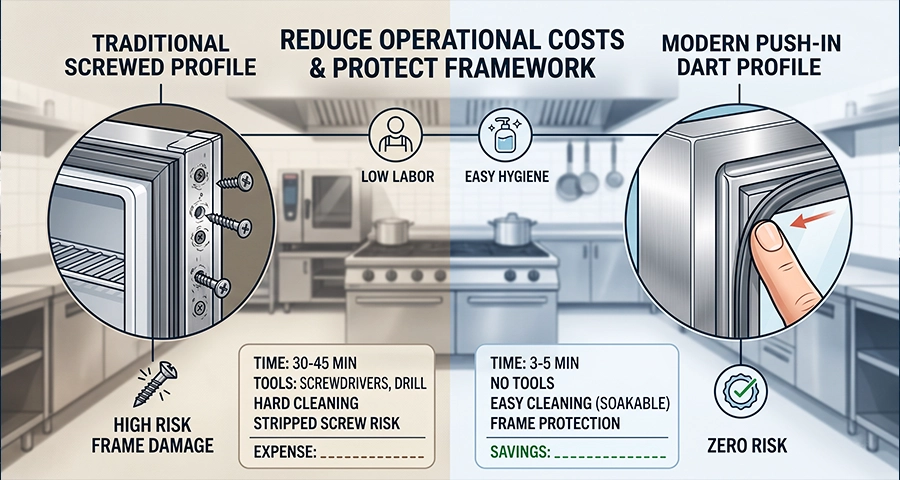
The Cost of Downtime: Traditional Screw-In vs Snap-In/Pushed Gasket Maintenance
Old commercial refrigerators use metal retainers and dozens of small screws to hold door gaskets in place. Replacing a damaged screw-in gasket is a tedious chore. A technician must back out dozens of rusted screws. They align the new strip carefully. They tighten every screw again. This repair takes forty-five minutes per door. Technician labor costs money. The refrigerator door stays open during the repair. Warm air fills the cabinet. Food must be moved to another unit. Modern push-in tool-less replacement gasket profiles change everything. They reduce maintenance repair duration from 45 minutes down to under 5 minutes per door. This virtually eliminates operational downtime. The technician simply pulls the old seal out of the channel with their fingers. They press the new gasket dart into the groove. No tools are needed.
Standardized Cleaning Protocols: Hygiene Compliance Made Fast and Simple for Kitchen Staff
Food safety inspectors inspect refrigerator gaskets carefully during kitchen audits. Black mold and food crumbs hide deep inside gasket folds. Cleaning screwed-in gaskets is hard work. Staff often skip this task because scrubbing tight rubber folds while attached to the door takes too long. Easily removable gasket assemblies fix this hygiene problem. They allow staff to execute standardized hygiene protocols without technical tools. This prevents mold growth and ensures HACCP compliance. Kitchen workers pull the entire seal off the door in five seconds during weekly deep cleaning. They soak the seal in warm soapy water. They sanitize the smooth stainless steel channel on the door easily. They push the gasket back into place. Health code compliance becomes fast and simple.
| Maintenance Task | Traditional Screw-In Profile | Modern Push-In Dart Profile |
|---|---|---|
| Replacement Time per Door | 30 to 45 minutes | 3 to 5 minutes |
| Tools Required | Screwdrivers, drill, metal strips | None (Manual press) |
| Deep Cleaning Effort | Hard (Done on the door) | Easy (Removable for soaking) |
| Risk of Frame Damage | High (Stripped screw holes) | Zero |
Why Equipment Distributors Should Prioritize Advanced Gasket Technology?
Are high warranty claims and after-sales service calls hurting your distribution margins? Selling low-durability hardware damages customer trust and drains profitability. Premium gasket technology protects your bottom line.
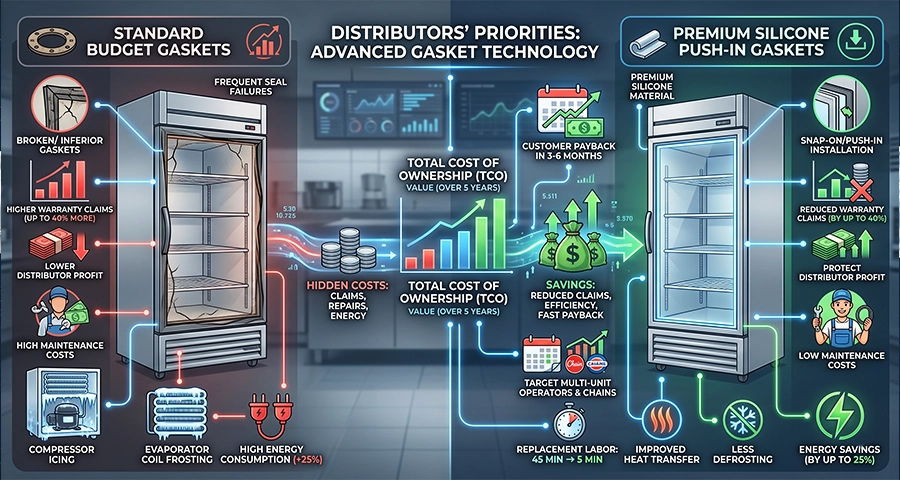
Distributors who specify advanced silicone and snap-in gasket hardware cut warranty service claims by up to 40%. Positioning energy-efficient door seals helps dealers demonstrate clear Total Cost of Ownership value to multi-unit operators.
Reducing After-Sales Service Claims and Warranty Costs for Dealers
Equipment dealers who specify advanced gasket hardware reduce after-sales warranty service claims by up to 40%. A major profit drain for equipment sellers is after-sales warranty service calls. A customer calls to report a cabinet that cannot hold temperature. The dealer sends a technician. The technician finds a leaking gasket that caused compressor ice buildup. Frost buildup on evaporator coils directly stems from gasket leakage. This reduces thermal transfer efficiency and requires more frequent defrost cycles. The warranty call costs the dealer time and money. By specifying high-performance silicone push-in gaskets across refrigeration units, dealers reduce gasket service claims significantly. The refrigeration units operate reliably from day one.
Pitching Value Over Price: Positioning Energy-Efficient Hardware to Commercial Restaurant Chains
Large restaurant chains buy equipment based on total cost of ownership. They do not look only at the initial purchase price. Intelligent buyers calculate energy consumption, service intervals, and maintenance costs over five years. Distributors can present clear numbers to restaurant buyers. Transitioning to premium, durable gasket materials offers commercial kitchens a full investment payback within 3 to 6 months via utility and maintenance savings. A heat-resistant push-in gasket saves money every single month. It cuts energy consumption by up to twenty-five percent. It drops replacement labor from forty-five minutes to five minutes. The client pays back the initial price difference quickly through lower utility bills. Demonstrating clear Total Cost of Ownership value builds long-term commercial partnerships.
| Value Proposition | Standard Budget Gasket | Advanced Silicone Push-In Gasket |
|---|---|---|
| Dealer Warranty Claims Rate | High (Frequent seal failures) | Very Low (Up to 40% reduction) |
| Client Payback Period | None | 3 to 6 months via energy savings |
| Target Customer Fit | Short-term low-budget buyers | Long-term chains and multi-unit operators |
| Total Cost of Ownership | High (Continuous repairs & power usage) | Low (Durable, energy-efficient) |
Conclusion
Worn magnetic gaskets waste electricity and strain refrigeration hardware. Upgrading to durable food-grade silicone push-in seals eliminates air leaks, cuts energy costs by 25%, and simplifies kitchen maintenance.