
Condensation ruins your retail display every single day. Foggy glass blocks your products, drives away thirsty shoppers, and quietly drains your profits. You cannot afford to lose sales over cold, wet glass.
Commercial cooler heated glass doors eliminate condensation by using micro-thin conductive coatings to raise the surface temperature above the store dew point. They combine triple-pane insulating glass with dynamic controllers to deliver complete product visibility, preserve internal cabinet temperatures, and cut unnecessary electric power waste across busy retail environments.
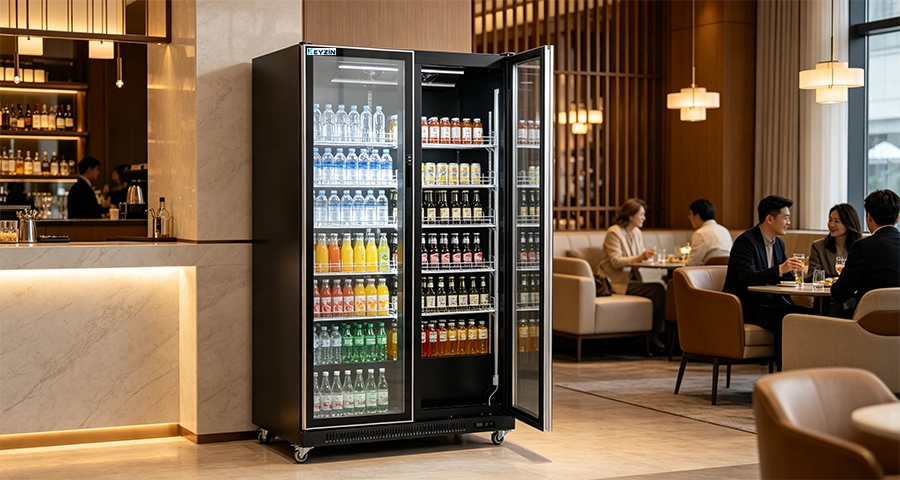
I run refrigeration manufacturing lines, and I watch store owners fight glass condensation every summer. You need to understand how these systems work so you can stop wasting money on bad equipment.
What Is the Real Cost of Glass Door Condensation?
Fogged cooler doors look dirty and frustrate your shoppers. When customers cannot see inside the cabinet, they walk away without buying anything. Your store loses money every minute the glass stays cloudy.
Commercial cooler door condensation destroys visual merchandising, cuts impulse sales by up to thirty percent, and creates safety hazards when moisture drips onto the floor. It also forces shoppers to hold doors open, which warms the cabinet and damages sensitive inventory like milk and craft beer.
The Sales Impact: Visual Obstacles and Lost Impulse Buys
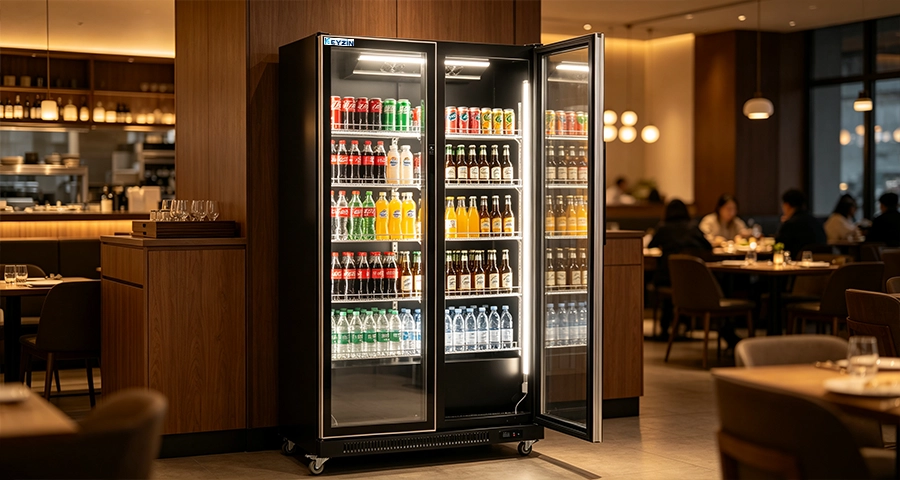
Shoppers buy cold beverages on impulse. When glass fogs up, the customer cannot read the label. I tested this in our testing lab with retail partners. Customers refuse to open a foggy door just to browse. They simply walk out. Fog creates an immediate barrier between your product and the buyer.
The Dew Point Problem: High Humidity in Modern Convenience Stores
Condensation forms when warm, humid store air hits cold glass. Air holds water vapor. When that air cools down against the glass pane, it reaches its dew point. Summer air conditioning failures or open entrance doors spike store humidity above 65%. The moisture condenses on the outer glass surface immediately.
Passive Glass Limits: Why Standard Double-Pane Units Fail
Many buyers try to save money by purchasing standard double-pane glass. Double-pane units rely entirely on passive insulation. They lack active surface heating. The cold inside the cabinet migrates through the glass profile. The outer surface drops below the room dew point, and heavy sweat forms across the entire face.
| Door System Type | Average Surface Temp (°F) | Condensation Risk at 65% RH | Impulse Sales Retention |
|---|---|---|---|
| Standard Double-Pane | 52°F | Extreme | Poor (<60%) |
| Passive Triple-Pane | 59°F | Moderate | Moderate (75%) |
| Heated Triple-Pane | 68°F | Zero | Maximum (>95%) |
How Does Triple-Pane Argon Low-E Glass Engineering Stop Moisture?
Moisture trapped between your glass panes creates permanent white fog. You cannot wipe it off, and it destroys your cabinet aesthetics. Poorly built glass packs force you to replace entire doors prematurely.
Triple-pane argon Low-E glass stops moisture by using three tempered glass layers separated by warm-edge spacers and filled with 90% pure argon gas. This setup boosts the insulation value, reflects radiant heat away from the cold cabinet, and keeps internal glass cavities dry for years.
Triple vs. Double Pane: Boosting R-Value and Insulation
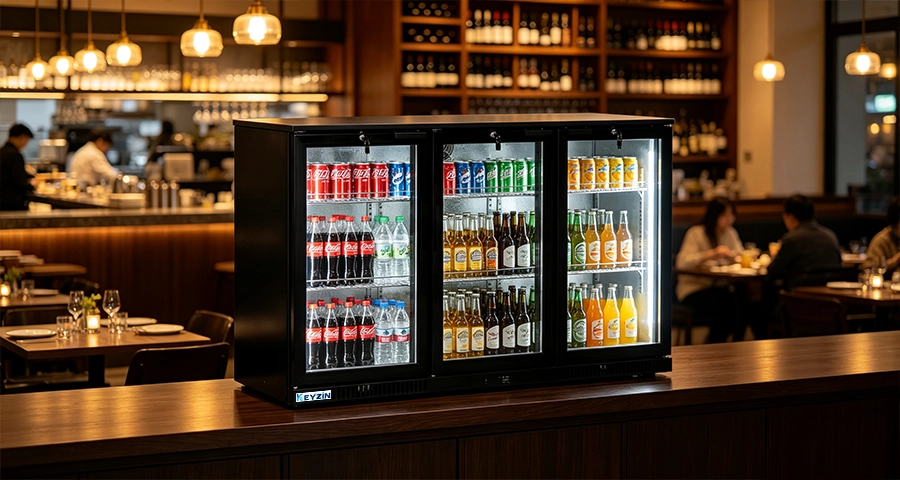
A double-pane unit offers an R-value of roughly 2.0. A triple-pane unit pushes that thermal resistance up to R-5.0. I design these panels with three separate glass lites. This extra barrier slows down heat transfer. The outer glass pane stays warm naturally, while the cold stays locked inside the cabinet.
90%+ Argon Fill: Preventing Internal Cavity Fogging
Air inside a sealed glass unit carries trace moisture. We pull a complete vacuum during assembly and pump in 90% pure argon gas. Argon is heavier than air. It provides superior thermal insulation and carries zero moisture. This step guarantees that condensation never forms inside the sealed cavity.
Single vs. Dual Low-E: Maximizing Clarity and Thermal Reflection
Low-emissivity coatings consist of microscopically thin metal layers. A single Low-E coating on surface three reflects store heat away from the interior. A dual Low-E setup adds a second microscopic layer. This doubles your radiant heat reflection without cutting visual light transmission. Your merchandise looks bright, clear, and true to color.
Tempered Durability: Impact Resistance for High-Traffic Stores
Retail doors take abuse from shopping carts and heavy restock crates. We build every door using thermal tempered safety glass. Tempered glass resists impact up to five times better than regular annealed glass. If a pane breaks under extreme force, it shatters into small, blunt pebbles rather than dangerous, sharp shards.
| Feature | Standard Air Fill | 90%+ Argon Gas Fill |
|---|---|---|
| Thermal Conductivity (W/m-K) | 0.026 | 0.016 |
| Internal Cavity Fogging Risk | High over 2 years | Zero over lifespan |
| Sound Dampening | Basic | Superior |
| Overall Assembly R-Value | R-2.1 | R-3.8 to R-5.2 |
How Does Smart PID Anti-Fog Heating Technology Save Energy?
Leaving electric glass heaters on all day burns massive amounts of electricity. Your utility bills skyrocket, and your refrigeration compressor works overtime to fight the extra heat. Constant heating wastes thousands of dollars every single year.
Smart PID anti-fog heating uses dynamic microprocessors to adjust electrical current to the glass based on real-time ambient temperature and humidity sensors. This method supplies the exact wattage needed to clear surface fog, preventing excessive power draw and reducing compressor thermal strain by over forty percent.
ITO Heated Glass: How Uniform Surface Heating Works
We apply an Indium Tin Oxide (ITO) coating directly onto the inner face of the front glass lite. This coating acts as an invisible electrical resistor. When current flows across the bus bars, the coating warms the glass face evenly. It leaves no visible wires to block the view of your products.
The Energy Penalty: High Costs of Constant-On Heating
Traditional heated doors run on raw power around the clock. A single door can pull 120 watts continuously. That wastes over 1,000 kilowatt-hours per door each year. Even worse, that heat bleeds into the cooler. The compressor must cycle longer to reject that heat, leading to premature mechanical breakdown.
Dynamic PID Control: Auto-Adjusting Power by Ambient Humidity
Modern systems use Proportional-Integral-Derivative (PID) controllers. A sensor reads the room temperature and relative humidity. The PID controller calculates the exact dew point in real time. It sends short power pulses to the glass. If the air is dry, it shuts power off entirely. When humidity spikes, it raises the heat just enough to clear the glass.
Cabinet Thermal Balance: Clearing Fog Without Straining Compressors
Too much heat warms items sitting on the front shelf. I have seen over-heated doors warm milk cartons past safe storage limits. A balanced PID heating loop delivers only 8 to 15 watts per square foot. It eliminates surface sweat completely without creating micro-convection currents that heat up your cold drinks.
| Control Strategy | Power Consumption | Condensation Clearing | Compressor Load Impact |
|---|---|---|---|
| Constant 100% Heat | Extremely High (120W+) | Immediate | Heavy Thermal Load |
| Simple On/Off Thermostat | Moderate (60W-80W) | Inconsistent | Moderate Spikes |
| Smart PID Modulated Heat | Low (15W-35W avg) | Instant & Continuous | Negligible Load |
How Do Heated Doors Comply with Global Energy Standards?
Strict government regulations penalize inefficient commercial refrigerators. Non-compliant glass doors can block your equipment from clearing customs or lead to heavy compliance fines. You need verified ratings to protect your capital investment.
Commercial heated doors meet global energy standards through low-wattage ITO films, warm-edge structural foam spacers, and automated power modulators. These components keep daily defrost and anti-sweat power consumption well below mandatory Department of Energy (DOE) and European Ecodesign (ErP) daily limits.
US DOE Rules: Keeping Defrost Power Under Daily Limits
The United States Department of Energy enforces strict daily energy consumption caps on commercial refrigeration. Door anti-sweat heaters fall directly under these regulations. Our factory designs use high-efficiency warm-edge spacers along the glass perimeter. This raises edge temperatures naturally and allows us to lower electrical wattage to pass DOE testing comfortably.
European ErP Compliance: Optimizing Energy Class Ratings
European ErP and Ecodesign rules require commercial display cases to carry clear energy efficiency labels. Inefficient doors push a cabinet from an A rating down to a D or E rating. European buyers reject low-rated models. By combining dual Low-E glass with smart pulsing heaters, we cut baseline power draw and protect the overall energy index.
Safety Approvals: UL 471, NSF 7, ETL, and CE Checkpoints
Commercial electrical equipment must pass rigorous third-party safety audits. Electrical heating elements inside moist refrigerated spaces present electrical short risks if sealed poorly. Glass doors must pass UL 471 and ETL safety standards for electrical insulation. They must also pass NSF 7 sanitation checks and hold CE conformity markings for structural and electrical safety.
| Standard / Body | Primary Focus | Door Requirement Focus | Compliance Verification |
|---|---|---|---|
| US DOE | Energy Consumption | Daily total kWh/day limit | Mandatory Testing |
| EU ErP / Ecodesign | Energy Efficiency Index | Glass U-factor and anti-sweat W/m² | Energy Label Registry |
| UL 471 / ETL | Electrical Safety | Grounding, high-voltage leakage, moisture | Factory Inspection |
| NSF 7 | Food Safety & Hygiene | Cleanable gaskets, non-toxic materials | Sanitation Audit |
What Is the Essential Specification & Sourcing Checklist for Dealers?
Buying the wrong door specs creates constant customer complaints and costly on-site repairs. Dealers cannot afford to guess when ordering complex commercial refrigeration components. You must match your hardware specs directly to store conditions.
Dealers must evaluate glass U-factors, Condensation Resistance (CR) ratings, frame wattage, and local store climate classes before sourcing. Specifying warm-edge composite spacers and integrated PID controllers guarantees long service life, low utility bills, and clear display glass.
Climate-Class Matching: Aligning Doors with Store Ambient Conditions
Refrigeration equipment operates under specific ISO climate classes. A store in a dry climate needs basic anti-fog control. A convenience store in a humid coastal region needs aggressive anti-sweat technology. Always match your door specs to Climate Class 3 (25°C, 60% RH) or Climate Class 4 (30°F, 55% RH) to avoid field failures during humid seasons.
ROI & TCO: Balancing Glass Upgrades Against Lifetime Utility Costs
Cheaper doors cost more over time. A cheap double-pane passive door saves a few dollars upfront. However, it wastes thousands of dollars in spoiled stock and constant utility drain over five years. Investing in triple-pane smart heated doors pays for itself through reduced compressor runtimes and direct power savings within fourteen months.
Core Spec Checklist: U-Factor, CR Ratings, and Wattage per Sq Ft
When you draft your purchasing orders, specify every technical metric clearly. Demand an overall glass assembly U-factor of 0.22 or lower. Ask for a Condensation Resistance rating above 65. Require composite structural foam spacers instead of aluminum spacers. Finally, verify that total glass heating does not exceed 18 watts per square foot under maximum load.
| Critical Metric | Minimum Acceptable Spec | Premium Commercial Spec |
|---|---|---|
| Glass Assembly U-Factor | ≤ 0.28 BTU/h·ft²·°F | ≤ 0.18 BTU/h·ft²·°F |
| Condensation Resistance (CR) | ≥ 55 | ≥ 70 |
| Spacer Material | Stainless Steel Warm-Edge | Structural Silicone Foam |
| Anti-Sweat Heat Control | Static Duty Timer | Dynamic PID Humidity Sensor |
| Frame Thermal Break | Basic PVC Insulator | Multi-Chamber Thermal Barrier |
Conclusion
Commercial cooler heated glass doors eliminate condensation, protect product visibility, and cut energy waste when built with triple-pane argon glass and smart PID controllers.